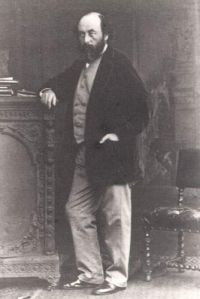
Joseph Beete Jukes

Joseph Beete Jukes

Summary

Portrait of Joseph Beete Jukes Joseph Beete Jukes The South Staffordshire Coalfield… (1859)

Marsupiocrinus celatus, two species of Pisocrinus (a minute fossil) , Tarocrinus tuberculatus, and Icthyocrinus pyriformis, with Glyptocrinus expansus, are quite common fossils; and the long necklace-like stems of Pertechocrinus moniliformis occur on almost every slab of Dudley limestone.
The corals are still more numerous, and though there is no evidence that the Dudley limestone possessed the character of a coral reef, yet the floor of the sea must have been nearly covered with them. They are chiefly solitary forms, however, never exceeding a foot or two in diameter, and even this is rare.
Source: Wikisource

Portrait of Joseph Beete Jukes Joseph Beete Jukes The South Staffordshire Coalfield… (1859)

Ptychophyllum patellatum and Heliolites inordinatus are conspicuous corals in the shale.
4. The Wenlock Limestone (divided into two bands by a thick layer of shale, as above described) contains all the fossils above noted, with the addition of a host of others. Indeed, the quarries of Dudley are the most famous in the world for Upper Silurian organisms. Shells, corals, encrinites of very numerous genera and species, and trilobites, are all in a state of perfection such as no other locality in Britain exhibits.
Source: Wikisource

Portrait of Joseph Beete Jukes Joseph Beete Jukes The South Staffordshire Coalfield… (1859)

The beds of quartz rock in the Lower Lickey range are tilted at high angles, and in some places much contorted, and the whole must have a thickness of 300 or 400 feet at least.
What influence it was that converted the rather soft sandstone that is to be seen at Barr into hard quartz rock at the Lickey we cannot exactly say, but as the quartz rock has apparently no other cement than a siliceous one, it seems impossible that dry heat could have effected it.
Source: Wikisource

Get perspective with Kwize: daily news enlightened by great literature