Summary

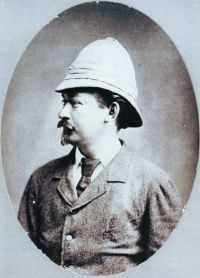
Portrait of Emil Holub Emil Holub Papers presented to the World's Congress on Ornithology (1896)

The grassy cover of the plain is about one yard high, and the slender stems of this high grass, waving to and fro in the northwesterly breeze, are interwoven with numerous blossoms, showing all the colors which form a rainbow’s beauty. Everywhere on the immense flat, bounded by the blue sky of the horizon only, whereto we turn our eyes, and plainly to be seen from the small hill, an elevation formed by the white alluvial karoo tuff-stone, herds of game are visible.
Source: Wikisource

Portrait of Emil Holub Emil Holub Papers presented to the World's Congress on Ornithology (1896)

Count now all the sleeping-places; count now all the swarms of this most useful bird; consider also the number of days of our winter, during which the Swallows remain in the far south; and if you have never before meditated on a small bird’s life, you will acquire a new notion: that you harm yourself and your children if you injure this true small friend. You will then recognize in yourself a protector not only of the Swallow but of all useful birds, which were sent into the world to do good to mankind, and are therefore not to be killed for vanity’s sake.
Source: Wikisource

Portrait of Emil Holub Emil Holub Papers presented to the World's Congress on Ornithology (1896)

The faded crimson on the western sky has disappeared. The evenings on these high African plateaus are very short. The night is fast approaching. Still the living, dark and noisy billow rolls up and down, a little less voluminous than before, as thousands have already joined the whistling Finches among the reeds. Suddenly the wave subsides, and turns sharply toward the grassy plain, as if it would leave the swamp for good; but just as suddenly it returns in a semicircle and striking the reeds sinks among them, not to rise again.
Source: Wikisource

Get perspective with Kwize: daily news enlightened by great literature