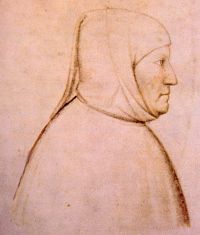
Francesco Petrarca

Francesco Petrarca

Summary

Portrait of Francesco Petrarca Francesco Petrarca Fifteen sonnets of Petrarch

One exquisite sonnet (I’ vidi in terra) shows this to have been true.
These sonnets are in Petrarch’s earlier manner; but the death of Laura brought a change. Look at yonder schooner coming down the bay straight toward us; she is hauled close to the wind, her jib is white in the sunlight, her larger sails are touched with the same snowy lustre, and all the swelling canvas is rounded into such lines of beauty as scarcely anything else in the world—hardly even the perfect outlines of the human form—can give.
Source: Gutenberg

Portrait of Francesco Petrarca Francesco Petrarca Fifteen sonnets of Petrarch

I fancy that this narrow cove prescribes the proper limits of a sonnet; and when I count the lines of ripple within yonder projecting wall, there proves to be room for just fourteen. Nature meets our whims with such little fitnesses. The words which build these delicate structures of Petrarch’s are as soft and fine and close-textured as the sands upon this tiny beach, and their monotone, if such it be, is the monotone of the neighboring ocean.
Source: Gutenberg

Portrait of Francesco Petrarca Francesco Petrarca Fifteen sonnets of Petrarch

Emboldened by such influences, at least let me translate a sonnet (Lieti fiori e felici) , and see if anything is left after the sweet Italian syllables are gone. Before this continent was discovered, before English literature existed, when Chaucer was a child these words were written. Yet they are to-day as fresh and perfect as these laburnum blossoms that droop above my head. And as the variable and uncertain air comes freighted with clover-scent from yonder field, so floats through these long centuries a breath of fragrance, the memory of Laura.
Source: Gutenberg

Get perspective with Kwize: daily news enlightened by great literature