Summary

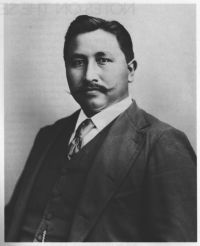
Portrait of Francis La Flesche Francis La Flesche The Osage tribe, two versions of the child-naming rite

When your little ones make of me their bodies,
They shall always be difficult to overcome by death.
Behold the locks that float about the edges of my head.
When the little ones reach old age,
Their locks shall float about the edges of their heads.
The little ones shall always live to see their locks grown scant with age.
The younger brothers spake, saying: Close to the God of Day who sitteth in the heavens,
We shall place the Little Rock.3
When our little ones make of the Little Rock their bodies,
Of the God of Day also
Our little ones shall make their bodies.
Source: Gutenberg

Portrait of Francis La Flesche Francis La Flesche The Osage tribe, two versions of the child-naming rite

Thus the house, the two gentes and all the others who enter it to take part in the rite become, collectively, a symbol of the universe wherein life manifests itself by taking on an infinite variety of bodily forms. The whole ceremony is an expression of a longing desire that Wa-ḳon ́-da who dwells in the universe will favor the little one who is to be named with a long life and an endless line of descendants.
Source: Gutenberg

Portrait of Francis La Flesche Francis La Flesche The Osage tribe, two versions of the child-naming rite

These also shall be food for the little ones!
And they shall be difficult for death to overcome them.
The feasting of the Non ́-hon-zhin-ga upon the fruits of the seeds of the maize planted by the mother with religious care in the seven sacred hills completes the rite of the naming of her child, by which its right to a place in its gens is formally recognized; the child has a place, not only in its gens, but also in the sky and the earth which the two great tribal divisions, the Hon ́-ga and the Ṭsi ́-zhu, represent.
Source: Gutenberg

Get perspective with Kwize: daily news enlightened by great literature