Summary

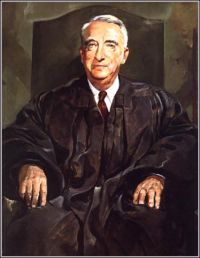
Portrait of Fred M. Vinson Fred M. Vinson Brock v. North Carolina — Dissent

He says that a state falls short of its obligation 'when it callously subjects an individual to successive retrials on a charge on which he has been acquitted or prevents a trial from proceeding to a termination in favor of the accused merely in order to allow a prosecutor who has been incompetent or casual or even ineffective to see if he cannot do better a second time.' In my view, this case is snugly embraced in his very clear statement of the law as I have always understood it until today.
Source: Wikisource

Portrait of Fred M. Vinson Fred M. Vinson Brock v. North Carolina — Dissent

Under the results reached by the Court, the state is free, if the prosecutor thinks a conviction probably cannot be won from the jury on the testimony at the trial, to stop the trial and insist that it be tried again on another day when it has stronger men on the field.
Orderly justice could not be secured if the rules allowed the defendant to ask for a mistrial at the conclusion of testimony just because the state had done well and the defense poorly. The same limitation applies to the prosecution if the scales of justice are to be kept in equal balance.
Source: Wikisource

Portrait of Fred M. Vinson Fred M. Vinson Brock v. North Carolina — Dissent

The rule to be gleaned from the cases is that a second trial will be allowed only for extreme circumstances, often contributed to by the defendant and beyond the control of the prosecutor, which prevented the testimony from being available at the first trial. Only North Carolina has clear precedent allowing a second trial when the prosecutor simply failed to have his evidence ready at the first trial.
Source: Wikisource

Get perspective with Kwize: daily news enlightened by great literature