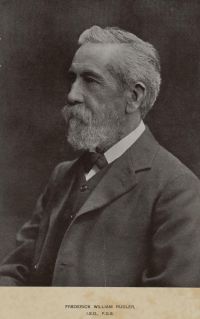
Frederick William Rudler

Frederick William Rudler

Summary

Portrait of Frederick William Rudler Frederick William Rudler 1911 Encyclopædia Britannica, Volume 22… (1911)

The Navajo Indians of New Mexico collect the garnet from the sands of the ant-hills and scorpion-holes. Very fine pyrope occurs in the diamond-fields of South Africa, having been derived from olivine-bearing rocks. It occurs in the blue-ground and in the detritus of the river-diggings. The Cape garnets have usually a rich colour, but some stones incline to an orange hue. The finest pyrope is often cut as a brilliant, and passes under the misleading name of “ Cape ruby.” A pyrope-bearing rock, rather like that of South Africa, occurs in Elliott county, Kentucky, U.S.A.
Source: Wikisource

Portrait of Frederick William Rudler Frederick William Rudler 1911 Encyclopædia Britannica, Volume 22… (1911)

The pyrope is generally rose-cut or step-cut, and often mounted with a foil. Beads are faceted all over. Some pyrope is cut en cabochon, forming, like almandine, carbuncle, and if very dark the stone is hollowed at the back so as to form a “ garnet shell." The industry of cutting Bohemian garnets is centred in Turnau on the Iser, near Reichenberg; but there are also works at other localities. Large stones are very rare, but a Bohemian pyrope as large as a hen's egg is preserved in the Imperial treasury at Vienna
Source: Wikisource

Get perspective with Kwize: daily news enlightened by great literature