Summary

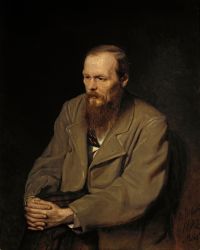
Portrait of Fyodor Dostoevsky Fyodor Dostoevsky The Brothers Karamazov — Part I, Book III, Chapter 3 (1880)

I can't endure the thought that a man of lofty mind and heart begins with the ideal of the Madonna and ends with the ideal of Sodom. What's still more awful is that a man with the ideal of Sodom in his soul does not renounce the ideal of the Madonna, and his heart may be on fire with that ideal, genuinely on fire, just as in his days of youth and innocence. Yes, man is broad, too broad, indeed.
Source: Wikisource

Portrait of Fyodor Dostoevsky Fyodor Dostoevsky The Brothers Karamazov — Part I, Book III, Chapter 3 (1880)

Am I to become a peasant or a shepherd? I go on and I don't know whether I'm going to shame or to light and joy. That's the trouble, for everything in the world is a riddle! And whenever I've happened to sink into the vilest degradation (and it's always been happening) I always read that poem about Ceres and man. Has it reformed me? Never! For I'm a Karamazov. For when I do leap into the pit, I go headlong with my heels up, and am pleased to be falling in that degrading attitude, and pride myself upon it. And in the very depths of that degradation I begin a hymn of praise.
Source: Wikisource

Portrait of Fyodor Dostoevsky Fyodor Dostoevsky The Brothers Karamazov — Part I, Book III, Chapter 3 (1880)

What to the mind is shameful is beauty and nothing else to the heart. Is there beauty in Sodom? Believe me, that for the immense mass of mankind beauty is found in Sodom. Did you know that secret? The awful thing is that beauty is mysterious as well as terrible. God and the devil are fighting there and the battlefield is the heart of man. But a man always talks of his own ache.
Source: Wikisource

Get perspective with Kwize: daily news enlightened by great literature