Geoffroy de la Tour Landry

Geoffroy de la Tour Landry

Summary

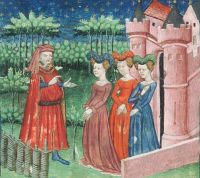
Portrait of Geoffroy de la Tour Landry Geoffroy de la Tour Landry The Book of the Knight of the Tower (1902)

The feminine iconoclast of to-day will note that the Knight of the Tower takes for granted, without stooping to argument, the superiority of spear over spindle and gather that then, as now, the sexes consisted of the fair and the unfair, though she will also observe that in a few follies and weaknesses not yet quite obsolete, such as an extravagant love of finery, or the inability to keep a secret, some old-fashioned women still resemble their mediaeval ancestresses.
Source: Wikisource

Portrait of Geoffroy de la Tour Landry Geoffroy de la Tour Landry The Book of the Knight of the Tower (1902)

The Knight's prologue sets forth how he came to compose the book for the instruction of his little girls, and now he employed "two preestes and two clerkes that he hadde" to collect the materials. He began to write in rhyme, but abandoned rhyme for prose almost immediately. Caxton's translation came into being at the desire of an English matron, whose name is not recorded, who so highly approved of the book that she wished her daughters to have the benefit of a version in their own language, and requested Caxton to furnish it.
Source: Wikisource

Portrait of Geoffroy de la Tour Landry Geoffroy de la Tour Landry The Book of the Knight of the Tower (1902)

But this will be seen to be a difference in manner rather than in essence; it was characteristic of the period; and though to us it appears a strange feature in a book intended for young women, it is one of which mediaeval readers would be perfectly unconscious.
As has been stated above, the present volume reproduces slightly more than half of Caxton's version of the Knight's book, and while omitting the coarser and the more tedious chapters, comprises all which is best adapted to reproduction in a popular form.
Source: Wikisource

Get perspective with Kwize: daily news enlightened by great literature