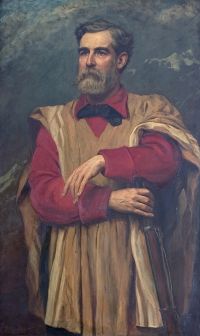
George Earl Church

George Earl Church

Summary

Portrait of George Earl Church George Earl Church 1911 Encyclopædia Britannica (1911)

A few miserable groups of Indians and half-breeds have their small villages along its southern portion. It is thus seen that this marvellous freak of nature is not, as is generally supposed, a sluggish canal on a flat tableland, but a great, rapid river which, if its upper waters had not found contact with the Orinoco, perhaps by cutting back, would belong entirely to the Negro branch of the Amazon.
Source: Wikisource

Portrait of George Earl Church George Earl Church 1911 Encyclopædia Britannica (1911)

The river Marañon rises about 100 m. to the north-east of Lima. It flows through a deeply-eroded Andean valley in a north-west direction, along the eastern base of the Cordillera of the Andes, as far as 5° 36′ S. lat.; then it makes a great bend to the north-east, and with irresistible power cuts through the inland Andes, until at the Pongo de Manseriche [2] it victoriously breaks away from the mountains to flow onwards through the plains under the name of the Amazon. Barred by reefs, and full of rapids and impetuous currents, it cannot become a commercial avenue.
Source: Wikisource

Portrait of George Earl Church George Earl Church 1911 Encyclopædia Britannica (1911)

Thus the first impulse of modern progress was given to the dormant valley. The success of the venture called attention to the unoccupied field; a second company soon opened commerce on the Madeira, Purús and Negro; a third established a line between Pará and Manãos; and a fourth found it profitable to navigate some of the smaller streams; while, in the interval, the Amazonas Company had largely increased its fine fleet. Meanwhile private individuals were building and running small steam craft of their own, not only upon the main river but upon many of its affluents.
Source: Wikisource

Get perspective with Kwize: daily news enlightened by great literature