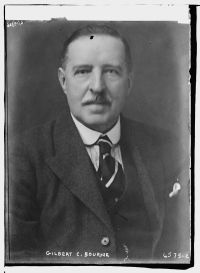
Gilbert Charles Bourne

Gilbert Charles Bourne

Summary

Portrait of Gilbert Charles Bourne Gilbert Charles Bourne 1911 Encyclopædia Britannica, Volume 7… (1911)

Starting from the well-known premise that reef-building species of corals do not flourish in a greater depth of water than 20 fathoms, Darwin argued that all coral islands must have a rocky base, and that it was inconceivable that, in such large tracts of sea as occur in the Pacific and Indian oceans, there should be a vast number of submarine peaks or banks all rising to within 20 or 30 fathoms of the surface and none emerging above it.
Source: Wikisource

Portrait of Gilbert Charles Bourne Gilbert Charles Bourne 1911 Encyclopædia Britannica, Volume 7… (1911)

In the present state of our knowledge it seems reasonable to conclude that coral reefs are formed wherever the conditions suitable for growth exist, whether in areas of subsidence, elevation or rest. A considerable number of reefs, at all events, have not been formed in areas of subsidence, and of these the Florida reefs, the Bermudas, the Solomon islands, and possibly the Great Barrier Reef of Australia are examples.
Source: Wikisource

Portrait of Gilbert Charles Bourne Gilbert Charles Bourne 1911 Encyclopædia Britannica, Volume 7… (1911)

Where the barrier reef is not far from the land there are always gaps in it opposite the mouths of rivers or considerable streams. The outer wall of a barrier reef is steep, and frequently, though not always, descends abruptly into great depths. In many cases in the Pacific Ocean a barrier reef surrounds one or more island peaks, and the strips of land on the edge of the reef may encircle the peaks with a nearly complete ring. An atoll is a ring-shaped reef, either awash at low tide or surmounted by several islets, or more rarely by a complete strip of dry land surrounding a central lagoon.
Source: Wikisource

Get perspective with Kwize: daily news enlightened by great literature