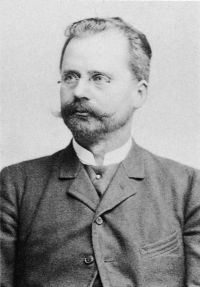
Gustaf de Laval

Gustaf de Laval

Summary

Portrait of Gustaf de Laval Gustaf de Laval United States patent 285584 (1883)

This invention relates to turbine motors in which the turbine has a central supply and direct action, and in which the shaft or axle of the turbine wheel is geared by means of friction bevel-wheels with the driving-shaft to which the motion is to be transmitted. The turbine wheel consists of one, two, or more curved tubes, the inner ends of which have a direction corresponding with that of the axis of rotation, and are presented toward inlet-pipe for the driving-fluid.
Source: Wikisource

Portrait of Gustaf de Laval Gustaf de Laval United States patent 285584 (1883)

R is the casing of the turbine, having the inlet f for steam, water, or other motive fluid, and an outlet, g. n is the turbine shaft, capable of sliding longitudinally in its bearings and fastened in the hub of the disk i. m is the main shaft, driven by the turbine and furnished with a pulley, o, for the transmission of power. c d are the bevel friction-gears through which the turbine shaft drives the shaft m. e is a set-screw for the bevel friction-gear.
Source: Wikisource

Portrait of Gustaf de Laval Gustaf de Laval United States patent 285584 (1883)

At the same time the driving fluid passes through the tubes and turns the turbine by reaction. In order to prevent the small friction bevel-wheel from losing its hold on the large one, it will be necessary to have the pressure between their surfaces not less than three times as great as the maximum value of the driving-power of the two wheels.
Source: Wikisource

Get perspective with Kwize: daily news enlightened by great literature