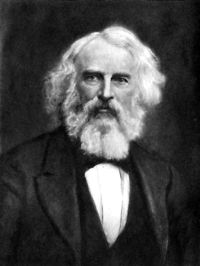
Henry Wadsworth Longfellow

Henry Wadsworth Longfellow

Summary

Portrait of Henry Wadsworth Longfellow Henry Wadsworth Longfellow Tales of a Wayside Inn — Part Third… (1863)

Thereupon answered Hannah the housemaid, the thrifty, the frugal:
"Yea, they come and they tarry, as if thy house were a tavern;
Open to all are its doors, and they come and go like the pigeons
In and out of the holes of the pigeon-house over the hayloft,
Cooing and smoothing their feathers and basking themselves in the sunshine."
But in meekness of spirit, and calmly, Elizabeth answered:
"All I have is the Lord's, not mine to give or withhold it;
I but distribute his gifts to the poor, and to those of his people
Who in journeyings often surrender their lives to his service.
Source: Wikisource

Portrait of Henry Wadsworth Longfellow Henry Wadsworth Longfellow Tales of a Wayside Inn — Part Third… (1863)

Thus rebuked, for a season was silent the penitent housemaid;
And Elizabeth said in tones even sweeter and softer:
"Dost thou remember, Hannah, the great May-Meeting in London,
When I was still a child, how we sat in the silent assembly,
Waiting upon the Lord in patient and passive submission?
No one spake, till at length a young man, a stranger, John Estaugh,
Moved by the Spirit, rose, as if he were John the Apostle,
Speaking such words of power that they bowed our hearts, as a strong wind
Bends the grass of the fields, or grain that is ripe for the sickle.
Source: Wikisource

Portrait of Henry Wadsworth Longfellow Henry Wadsworth Longfellow Tales of a Wayside Inn — Part Third… (1863)

Dost thou remember me still, Elizabeth? After so many
Years have passed, it seemeth a wonderful thing that I find thee.
Surely the hand of the Lord conducted me here to thy threshold.
For as I journeyed along, and pondered alone and in silence
On his ways, that are past finding out, I saw in the snow-mist,
Seemingly weary with travel, a wayfarer, who by the wayside
Paused and waited.
Source: Wikisource

Get perspective with Kwize: daily news enlightened by great literature