Summary

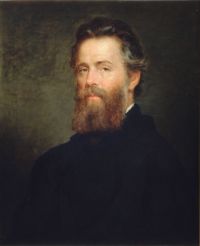
Portrait of Herman Melville Herman Melville Mardi — Volume I/Chapter XIX: Who Goes There… (1849)

Instantly our sails were struck; and calling upon Jarl, who was somewhat backward to obey, I shipped the oars; and, both rowing, we stood away obliquely from our former course.
I divined that the vessel was a whaler; and hence, that by help of the glass, with which her look-outs must be momentarily sweeping the horizon, they might possibly have descried us; especially, as we were due east from the ship; a direction, which at sunset is the one most favorable for perceiving a far-off object at sea. Furthermore, our canvas was snow-white and conspicuous.
Source: Wikisource

Portrait of Herman Melville Herman Melville Mardi — Volume I/Chapter XIX: Who Goes There… (1849)

In sight at gray dawn, the distant vessel, though in reality approaching, recedes from view, as the sun rises higher and higher. This holds true, till its vicinity makes it readily fall within the ordinary scope of vision. And thus, too, here and there, with other distant things: the more light you throw on them, the more you obscure. Some revelations show best in a twilight.
The sight of the stranger not a little surprised us. But brightening up, as if the encounter were welcome, Jarl looked happy and expectant.
Source: Wikisource

Portrait of Herman Melville Herman Melville Mardi — Volume I/Chapter XIX: Who Goes There… (1849)

Yea, all the woods in Canada charred down to cinders would not be worth the one famed Brazilian diamond, though no bigger than the egg of a carrier pigeon. Ah! but these chemists are liars, and Sir Humphrey Davy a cheat. Many's the poor devil they've deluded into the charcoal business, who otherwise might have made his fortune with a mattock.
Source: Wikisource

Get perspective with Kwize: daily news enlightened by great literature