Summary

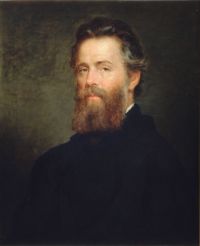
Portrait of Herman Melville Herman Melville Mardi — Volume I/Chapter XXXIV: How They Steered On Their Way (1849)

And the apprehensions, nay terrors I felt, were much augmented by the remissness of both Jarl and Samoa, in keeping their night-watches. Several times I was seized with a deadly panic, and earnestly scanned the murky horizon, when rising from slumber I found the steersman, in whose hands for the time being were life and death, sleeping upright against the tiller, as much of a fixture there, as the open-mouthed dragon rudely carved on our prow.
Source: Wikisource

Portrait of Herman Melville Herman Melville Mardi — Volume I/Chapter XXXIV: How They Steered On Their Way (1849)

Tell us, what hidden law regulates their flow. Regardless of the theory which ascribes to them a nearly uniform course from east to west, induced by the eastwardly winds of the Line, and the collateral action of the Polar streams; these currents are forever shifting. Nor can the period of their revolutions be at all relied upon or predicted.
But however difficult it may be to assign a specific cause for the ocean streams, in any part of the world, one of the wholesome effects thereby produced would seem obvious enough.
Source: Wikisource

Portrait of Herman Melville Herman Melville Mardi — Volume I/Chapter XXXIV: How They Steered On Their Way (1849)

Calms, light breezes, and currents made every thing uncertain. Nor had we any method of estimating our due westward progress, except by what is called Dead Reckoning,—the computation of the knots run hourly; allowances' being made for the supposed deviations from our course, by reason of the ocean streams; which at times in this quarter of the Pacific rim with very great velocity.
Now, in many respects we could not but feel safer aboard the Parki than in the Chamois. The sense of danger is less vivid, the greater the number of lives involved.
Source: Wikisource

Get perspective with Kwize: daily news enlightened by great literature