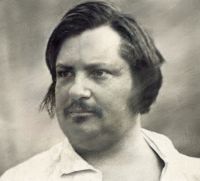
Honoré de Balzac

Honoré de Balzac

Summary

Portrait of Honoré de Balzac Honoré de Balzac Domestic Peace (1830)

Solemn silence now reigned in the room, where curiosity was at the highest pitch. All these eager faces wore the strangest mixed expressions; every one apprehended one of those outbreaks which men of breeding carefully avoid. Suddenly the Count's pale face turned as red as the scarlet facings of his coat, and he fixed his gaze on the floor that the cause of his agitation might not be guessed. On catching sight of the unknown lady humbly seated by the pedestal of the candelabrum, he moved away with a melancholy air, passing in front of the lawyer, and took refuge in one of the cardrooms.
Source: Wikisource

Portrait of Honoré de Balzac Honoré de Balzac Domestic Peace

At this moment Madame de Lansac, who seemed to be interested in the personages of this drama, could easily guess the agitation which the Countess was going through. The lady might fan herself gracefully, smile on the young men who bowed to her, and bring into play all the arts by which a woman hides her emotion,—the Dowager, one of the most clear-sighted and mischief-loving duchesses bequeathed by the eighteenth century to the nineteenth, could read her heart and mind through it all.
Source: Gutenberg

Portrait of Honoré de Balzac Honoré de Balzac Domestic Peace (1830)

Indeed, every face seemed to dilate with relief when his morose and crabbed countenance was no longer to be seen under the circle of light which a shaded lamp casts on a gaming-table.
"Those fiends of soldiers are always as thick as thieves at a fair!" said a diplomate who had been looking on, as he took Soulanges' place. One single pallid and fatigued face turned to the newcomer, and said with a glance that flashed and died out like the sparkle of a diamond: "When we say military men, we do not mean civil, Monsieur le Ministre."
Source: Wikisource

Get perspective with Kwize: daily news enlightened by great literature