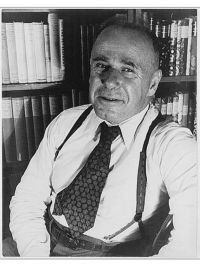
“ A French sailor, Pierre Gerard, who has left a memoir of the battle, tells how his countrymen responded to Jones's presence: "Commodore Jones sprang among the shaking marines on the quarter-deck like a tiger among calves. They responded instantly to him. In an instant they were filled with courage! The indomitable spirit, the unconquerable courage of the commodore penetrated every soul, and every one who saw his example or heard his voice became as much a hero as himself!" ”
Summary
“Paul Jones”, is a work by Hutchins Hapgood. It explores elements such as Jones, the United States and Serapis.
Quotes from Paul Jones (Hutchins Hapgood)
“ As far as his deeds are concerned, Paul Jones appears in the popular consciousness as he really was,—a bolt of effectiveness, a desperate, successful fighter, a sea captain whose habit was to appear unexpectedly to confound his enemies, and then to disappear, no one knew where, only to reappear with telling effect. He has been the hero of the novelists, who, expressing the popular idea, have pictured him with essential truth. A popular hero, indeed, he was, and will remain so, justly, in the memory of men. ”
“ But ill as I am, there is yet something left of the man—not the admiral, not the chevalier—but the plain, simple man whom it delights me to hear you call 'Paul Jones,' without any rank but that of fellowship, and without any title but that of comrade. So now I say to you that whatever is left of that man, be it never so faint or feeble, will be laid, if necessary, upon the altar of French Liberty as cheerfully as a child lies down to pleasant dreams! ”
“ He was a hero, however, with a thorny path all through life. He arrived at Brest with a miserably clothed, wholly unpaid, discontented, and partly mutinous crew. During the voyage his first lieutenant, Simpson, had stirred up dissatisfaction among the men, and had refused to obey orders, for which Jones had him put in irons. The unpaid men, not assigning their troubles to the true but unseen cause, the poverty of the government, easily believed that their captain was responsible for all their ills. ”
“ One was a long, logical argument in favor of swift frigates of a certain size, rather than ships of the line, and showed thorough knowledge, not only of naval construction and cost of building, but also of the general international situation, and the best method of conducting the war on the sea. On the latter point he wrote: "Keeping such a squadron in British waters, alarming their coasts, intercepting their trade, and descending now and then upon their least protected ports, is the only way that we, with our slender resources, can sensibly affect our enemy by sea-warfare." ”
“ Paul Jones has been called by his friends patriot, and by his enemies pirate. In reality he was neither. He was not one of those deeply ethical natures that subordinate personal glory and success to the common good. As an American he cannot be ranked with his great contemporaries, for his patriotism consisted merely in being fair and devoted to the side he had for the time espoused rather than in quiet work as a citizen after the spectacular opportunity had passed. He was ready to serve wherever he saw the best chance for himself, whether it was with the United States, Russia, or France. ”
“ Though I have drawn my sword in the present generous struggle for the rights of men, yet I am not in arms as an American, nor am I in pursuit of riches. My fortune is liberal enough, having no wife nor family, and having lived long enough to know that riches cannot secure happiness. ”
“ Now at an opportune moment, a hand grenade fell among a pile of cartridges strung out on the deck of the Serapis and caused a terrible explosion, killing many men. This seemed to reduce materially the fighting appetite of the British, and soon after a party of seamen from the Richard, with the dashing John Mayrant at their head, boarded the Serapis, and met with little resistance. Captain Pearson thereupon struck his colors, and the victory which marked the zenith of Jones's career, and upon which all else in his life merely served as commentary, was scored. ”
“ The flag and the commissions of the officers were American. The object of the French government was to secure the services of the marauding Jones against the coasts and shipping of England. This could better be done under the United States flag than under that of France; for the rules of civilized warfare had up to that time prevented the British from ravaging the coasts of France as they had those of rebel America, and France was therefore not morally justified in harassing the English shipping and coasts directly; as, on the principle of retaliation, it was fair for America to do. ”
“ Jones found himself in a position at the Texel which demanded all the shrewdness as well as the determination of his character. Impatient, irritable, and passionate as he often was, his judgment was nevertheless excellent. Benjamin Franklin, when Jones at a later time was again put in a delicate situation, wrote him:—"You have shown your abilities in fighting; you have now an opportunity of showing the other necessary part in the character of a great chief,—your abilities in policy." ”
“ If we show to the world that we can beat them afloat with an equal force, ship to ship, it will be more than anyone else has been able to do in modern times, and it will create a great and most desirable sentiment of respect and favor towards us on the continent of Europe, where really, I think, the question of our fate must ultimately be determined. ”
“ He wrote M. Chaumont, that patriotic and benevolent gentleman whom Jones alternately flattered and reviled, a rather typical letter: "I wish to have no connection with any ship that does not sail fast; for I intend to go in harm's way. You know, I believe, that this is not every one's intention. Therefore buy a frigate that sails fast, and that is sufficiently large to carry twenty-six or twenty-eight guns on one deck. I would rather be shot ashore than sent to sea in such things as the armed prizes I have described." ”
“ On June 14, 1777, Congress appointed him to the command of the sloop of war Ranger, eighteen guns, and on the same day the permanent flag of the United States was determined upon. Jones, as [Pg 26] usual, saw his spectacular opportunity and said: "That flag and I are twins; born the same hour from the same womb of destiny. We cannot be parted in life or in death. So long as we can float, we shall float together. If we must sink, we shall go down as one!" ”
“ To build regular warships on a large scale was impossible for a nation so badly in need of funds. It was almost equally difficult to secure officers trained in naval matters, for the marine captains, although as a rule good seamen, were utterly lacking in naval knowledge and the principles of organization.In this state of affairs Paul Jones proved a very useful man. He was not only a thorough seaman, but had studied the art of naval warfare, was in some respects ahead of his time in his ideas of armament, and was familiar with the organization and history of the British navy. ”
“ At the close of the journal of the Liman campaign Jones's bitterness is pathetically expressed in inflated self-praise, called out by the desire to confute the calumnies of his enemies. "Every one to whom I have the honor to be known," he wrote, "is aware that I am the least selfish of mankind.... This is known to the whole American people.... Have I not given proofs sufficiently striking that I have a heart the most sensitive, a soul the most elevated?... I am [Pg 117] the only man in the world that possesses a sword given by the king of France ... ”
“ On the John O'Gaunt, in which Jones shipped for England, after leaving Jamaica, the captain, mate, and all but five of the crew died of yellow fever, and the ship was taken by Paul into Whitehaven. For this he received a share in the cargo, and in 1768, when he was twenty-one years old, the owners of the John (a merchantman sailing from the same port) gave him command, and in her he made several voyages to America. Life on a merchantman is rough enough to-day, and was still rougher at that time. ”
“ There is no one to take the place of Mirabeau." Of the mob Jones wrote with [Pg 120] aristocratic hatred: "There have been many moments when my heart turned to stone towards those who call themselves 'the people' in France. More than once have I harbored the wish that I might be intrusted by Lafayette with the command of the Palace, with carte blanche to defend the constitution; and that I might have once more with me, if only for one day, my old crews of the Ranger, the Richard, and the Alliance! ”
“ The Drake, indeed, was almost a wreck, while the Ranger was little injured. Jones lost only two men killed and six wounded, to the enemy's approximate loss of forty-two killed and wounded. It was the first battle of the war which resulted in the capture of a regular British man-of-war by a ship of equal if not inferior force. The Drake belonged to a regularly established navy, not accustomed to defeat. ”
“ He had trouble with an insubordinate first lieutenant. He began, too, his social career in France. It was then that he met the Duchesse de Chartres, great-granddaughter of Louis XIV. and mother of Louis Philippe, who at a later time called Jones the Bayard of the Sea, and whom Jones at that time [Pg 29] promised "to lay an English frigate at her feet." He kept his word in spirit, for years afterwards he gave her the sword of Captain Pearson, commander of his famous prize, the Serapis. ”
“ The flagship, the Bonhomme Richard, was a worn-out old East Indiaman, which Jones refitted and armed with six eighteen-pounders, twenty-eight twelve-pounders, and eight nine-pounders—a battery of forty-two guns. The crew of 375, of many nationalities, contained, when the fleet sailed, only about fifty Americans; but fortunately, a few days later, Jones was compelled to put back to port, where he was unexpectedly able, owing to a recent exchange of prisoners, to get rid of some of his aliens, and to secure 114 American officers and sailors, who proved to be the backbone of the Richard's crew. ”
“ George Washington, one of whose great qualities was the power to know men, read this report of Jones and said: "Mr. Jones is clearly not only a master mariner within the scope of the art of navigation, but he also holds a strong and profound sense of the political and military weight of command on the sea. His powers of usefulness are great and must be constantly kept in view."Jones was appointed first lieutenant in the navy on the 22d of December, 1775. ”
“ Hardly had the battle begun when two of the six old eighteen-pounders forming the battery of the lower gun-deck of the Richard exploded, killing the men working them and rendering the whole battery useless for the [Pg 57] rest of the action. Captain Pearson, perceiving his advantage in speed and power of shot, attempted again and again to pass the bow of the Richard and rake her. Jones's whole effort, on the other hand, was to close with the Serapis and board, knowing that it was only a question of time when, in a broadside fight, the Richard would be sunk. ”
“ For Mirabeau, as for other really great men Jones knew,—Franklin, Washington, and Suwarrow,—he had extreme admiration, and on the occasion of the famous Frenchman's death wrote: "I have never seen or read of a man capable of such mastery over the passions and the follies of such a mob. ”
“ The next public business of Jones was to attempt to collect indemnity from the Danish government for the delivery to England of the prizes sent by the mad Landais, during Jones's most famous cruise, to Bergen, Denmark. He delayed his trip to Copenhagen, however, for a number of reasons. At this time he was carrying on several private business enterprises of importance, was occupied with society in London and Paris, and was eagerly desirous of being sent by the French government against the Dey of Algiers, who held in bondage many Christians. ”
“ The United States, however, were after the war lacking so completely in resources that a war with the pirates was impossible, and France was on the brink of her great Revolution, and had more important things to consider. So Jones died before the expedition for which he had so ardently hoped, and which brought so much honor, as he had [Pg 103] predicted, to the man who commanded it—Commodore Dale, once Jones's first lieutenant on the Bonhomme Richard—was dispatched. ”
“ Beyond this, if by exceedingly desperate fighting, one of our ships shall conquer one of theirs of markedly superior force, we shall be hailed as the pioneers of a new power on the sea, with untold prospects of development, and the prestige if not the substance of English dominion over the ocean will be forever broken. ”
“ As it was, he was compelled to put back for repairs to L'Orient, where, in a series of letters, he manœuvred in vain for the loan of the fine ship Terpsichore.It was not until December 18 that the Ariel got under way again for America. [Pg 92] The voyage was uneventful, with the exception of a night battle with a British privateer sloop of inferior force. Jones cleverly concealed his greater strength, and thus lured the Englishman to engage. After a ten-minute fight, the Triumph struck its colors, but, when the Ariel ceased firing, sailed away and escaped, to Jones's exceeding mortification. ”
“ Jones left Copenhagen on his ill-fated Russian mission, April 11, and made a flying and perilous trip to St. Petersburg. He crossed the ice-blocked Baltic in a small boat, compelled, at the muzzle of his pistols, the unwilling boatmen to proceed, and on his [Pg 107] arrival at his destination, on April 23, was presented to the empress, who conferred upon him the coveted rank of rear-admiral, to the intense irritation of many of the English officers in the service of Russia, who looked upon Jones as a red-handed pirate. ”
“ Fanning has many anecdotes to relate in regard to Jones's affairs of gallantry of an humble character. Several of Jones's biographers have dwelt upon the gorgeous and aristocratic nature of the hero's amours. Fanning has the solitary distinction of narrating the other side. Jones, indeed, was a good deal of a snob, but he was broadly appreciative of the fair sex. He probably was never deeply in love with anybody, certainly not with any woman of humble character. ”
Common terms
Similar works
Commodore Paul Jones (Cyrus Townsend Brady…The Story of John Paul Jones (Chelsea Curtis Fraser…Paul Jones (Molly Elliot Seawell…The Story of Paul Jones: An Historical Romance…Four American Naval Heroes (Mabel Borton Beebe…Twelve Naval Captains (Molly Elliot Seawell…The American Navy (French Ensor Chadwick…The history of our Navy from its origin to the present day…The Story of Commodore John Barry…Stories of Our Naval Heroes Every Child Can Read
