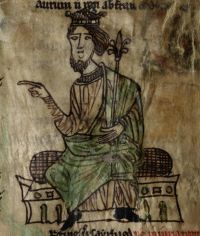
Hywel ap Cadell

Hywel ap Cadell

Summary

Portrait of Hywel ap Cadell Hywel ap Cadell The Laws of Howel the Good (1909)

Gwlad implies both the definite territory which is held by a ' people ' and also the ' people ' itself organized into a polity. Pre-Norman Wales (or Britannia as it was called) was not itself a gwlad, but a group of gwlads, somewhat like Germany before 1870. Dyved, Gwynedd, Powys, Morgannwg, &c. (which now make up the single gwlad or patria of Wales) , would be as distinct from one another as Wessex, Kent, Mercia, and the rest of the gwlads or patrias which formerly made up what is now the single gwlad or patria of England.
Source: Wikisource

Portrait of Hywel ap Cadell Hywel ap Cadell The Laws of Howel the Good (1909)

Every king in the Deheubarth having fallen, with the exception of the King of Ystrad Tywi and Ceredigion, it is only natural that his curia principalis should assume a unique position in Welsh eyes. Dinevwr does not become historic until it stands alone as the stronghold of the last great native princes of South Wales.
Source: Wikisource

Portrait of Hywel ap Cadell Hywel ap Cadell The Laws of Howel the Good (1909)

The term Deheubarth at no time stood for the whole of modern South Wales as signifying a definite patria under one king, like Gwynedd, Buallt, or Morgannwg. Deheubarth was used as a general term for that group of South Welsh patrias whose inhabitants might be described as Deheubarthwyr or Britonnes dexterales or simply Dextrales, [25] in contradistinction to those of Gwynedd and Powys. The Deheubarth was never a gwlad, but only a district which comprised many gwlads.
Source: Wikisource

Get perspective with Kwize: daily news enlightened by great literature