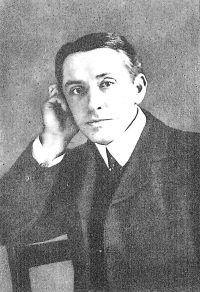
J. S. Fletcher

J. S. Fletcher

Summary

Portrait of J. S. Fletcher J. S. Fletcher The Copper Box — Chapter 10 (1923)

There was considerable satisfaction in travelling with Parslewe, for he reduced the whole thing to the perfection of comfort. He had already booked three places and a table in the first-class dining-car, armed himself with a heap of magazines and newspapers, and, as he said, we had nothing to do but drop on our padded seats, put our toes under the table, and go away in luxurious idleness. We went—but when that train moved out of Newcastle and started on its long journey southward, neither Madrasia nor myself bad the faintest idea as to where we were going.
Source: Wikisource

Portrait of J. S. Fletcher J. S. Fletcher The Copper Box — Chapter 10 (1923)

I observed. “Adds variety to life. He may have something quite exciting in store for us to-day.”
“Oh, well,” she said. “If you like to be led about like a performing bear—however, here he is!”
Parslewe and breakfast came together. He had evidently been down to the bookstall to buy a financial paper, and he sat, grim and fixed of expression, as he ate and drank, and read figures and statistics. It was not until he had made an end of his food that he betrayed any particular consciousness of our presence.
Source: Wikisource

Portrait of J. S. Fletcher J. S. Fletcher The Copper Box — Chapter 10 (1923)

Matthew Palkeney, of Palkeney Manor, away there in the Midlands, who died some little time ago, leaving money and a fine place and no relatives, and from whose library that copper box and those books were undoubtedly stolen?”
“I’ve heard of him—and of the rest,” I replied.
“Just so,” he said. “Well, Mr. Craye, between you and me, it’s my belief that the document Mr. Parslewe got from Bickerdale last night—or, rather, early this morning—was neither more nor less than Mr. Matthew Palkeney’s will, which the old fellow—a queer old stick!—had hidden in that copper box! That’s what I think!”
Source: Wikisource

Get perspective with Kwize: daily news enlightened by great literature