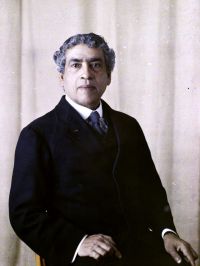
Jagadish Chandra Bose

Jagadish Chandra Bose

Summary

Portrait of Jagadish Chandra Bose Jagadish Chandra Bose Response in the Living and Non-Living (1902)

Not only does the point stimulated show the effect of stimulus, but that effect may sometimes be conducted even to a con- siderable distance. This power of conducting stimulus, though common to all living substances, is present in very different degrees. While in some forms of animal tissue irritation spreads, at a very slow rate, only to points in close neighbourhood, in other forms, as for example in nerves, conduction is very rapid and reaches far.
The visible mode of response by change of form may perhaps be best studied in a piece of muscle.
Source: Wikisource

Portrait of Jagadish Chandra Bose Jagadish Chandra Bose Response in the Living and Non-Living (1902)

Mechanical response —Different kinds of stimuli—Myograph—Characteristics of response-curve: period, amplitude, form—Modification of response-cumes.
ONE of the most striking effects of external disturbance on certain types of living substance is a visible change of form. Thus, a piece of muscle When pinched contracts. The external disturbance Which produced this change is called the stimulus. The body which is thus capable of responding is said to be irritable or excitable. A stimulus thus produces a state of excitability which may sometimes be expressed by change of form.
Source: Wikisource

Get perspective with Kwize: daily news enlightened by great literature