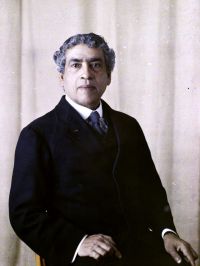
Jagadish Chandra Bose

Biographical details

Portrait of Jagadish Chandra Bose Jagadish Chandra Bose,  Collected Physical Papers (1927)

“ Amongst such phenomena, how can we draw a line of demarcation, and say, "here the physical process ends, and there the physiological begins"? No such barriers exist.
Do not the two sets of records tell us of some property of matter common and persistent? Do they not show us that the responsive processes, seen in life, have been foreshadowed in non-life?—that the physiological is, after all, but an expression of the physico-chemical, and that there is no abrupt break, but a continuity?
”
Source: Wikisource

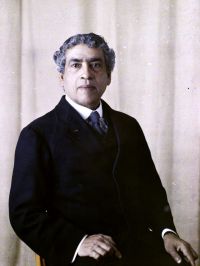
Portrait of Jagadish Chandra Bose Jagadish Chandra Bose,  Collected Physical Papers (1927)

“ Thus, electrical response is regarded as the criterion between the living and non-living. Where it is, life is said to be; where it is not found, we are in presence of death, or else of that which has never lived: for in this respect there is a great gulf fixed between the organic living and the inorganic or non-living. The phenomena of the inorganic are supposed to be dominated merely by physical forces, while on the other side of the chasm, in the domain of the living, inscrutable vital phenomena, of which electric response is the sign-manual, suddenly come into action. ”
Source: Wikisource

Portrait of Jagadish Chandra Bose Jagadish Chandra Bose,  On the Strain Theory of Photographic Action (1901)

“ It is an arbitrary distinction to call a phenomenon either physical or chemical when it happens to be on the common borderland. I have shown that when a substance is molecularly strained by light, its chemical activity is modified in consequence of the physical strain. The acted and the unacted portions will therefore be unequally attacked by a developer. In the case of a compound, the strain produced by light may cause a modification which renders it susceptible to decomposition by the action of a reducing agent. ”
Source: Wikisource

Get perspective with Kwize: daily news enlightened by great literature