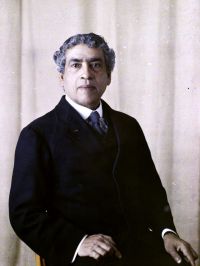
 Jagadish Chandra Bose,
On Polarisation of Electric Rays by Double Refracting Crystals
(1895)
Jagadish Chandra Bose,
On Polarisation of Electric Rays by Double Refracting Crystals
(1895)
“ There was no action on the Galvanometer, when the principal plane coincided with the planes of polarisation of either the Polariser or Analyser. With ordinary light a piece of Tourmaline of sufficient thickness absorbs the ordinary, but transmits the extraordinary ray. With the piece of Tourmaline used in the last experiment I found both the rays transmitted, but, it seemed to me, with unequal intensities. In other words, one ray suffers greater absorbtion than the other. It seems probable that with greater thickness of crystal one ray would be completely absorbed. ”
