Summary

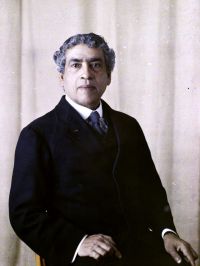
Portrait of Jagadish Chandra Bose Jagadish Chandra Bose On the Rotation of Plane of Polarisation of Electric Waves by a Twisted Structure (1898)

The assumption of any particular arrangement of molecules is thus not necessary in explaining the rotation. The average effect produced by a large number of active elements interspersed in an inactive medium will thus be the same in all directions, and proportional to the number of molecules traversed by the ray. As there is no polarity in the molecule, a right-handed element will always produce the same kind of rotation, say, to the right of an observer travelling with the ray.
Source: Wikisource

Portrait of Jagadish Chandra Bose Jagadish Chandra Bose On the Rotation of Plane of Polarisation of Electric Waves by a Twisted Structure (1898)

It is just possible that the light, in traversing a solution in which the molecules are free to move, may, on account of some peculiarity of structure, cause the molecules to take up some special arrangement, so that the fluid becomes as it were polarised by the transmission of the light, in a manner somewhat analogous to that in which a fluid dielectric is polarised in a field of electrostatic force.
Source: Wikisource

Portrait of Jagadish Chandra Bose Jagadish Chandra Bose On the Rotation of Plane of Polarisation of Electric Waves by a Twisted Structure (1898)

In order that the surface of the radiator should be little affected by the disintegrating action of the sparks, I use a single spark for producing a flash of radiation. There used to be, however, some uncertainty from a discharge occasionally failing to be oscillatory. The cause of this uncertainty is ascribed to the deposit of dust on the sparking surface. For greater certainty of action some observers immerse the radiator in oil. The use of oil is under any circumstances troublesome. This is specially so in polarisation experiments, when the radiator has to be placed in different azimuths.
Source: Wikisource

Get perspective with Kwize: daily news enlightened by great literature