Summary

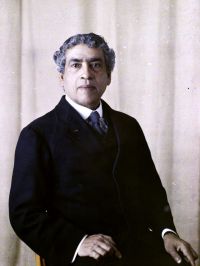
Portrait of Jagadish Chandra Bose Jagadish Chandra Bose On the Determination of the Index of Refraction of Glass for the Electric Ray (1897)

I have hitherto preferred the null method in my experiments, as it possesses many advantages. The sensitiveness of the receiver can be pushed to the utmost extent, and observations taken when no effect is produced on the receiver. The total reflection method also dispenses with the difficulty of making accurate measurement of the deviation produced. After obtaining the value of the index by the method described above, I was desirous to see whether it was not possible to obtain fairly good results by measuring the angle of refraction corresponding to a given angle of incidence.
Source: Wikisource

Portrait of Jagadish Chandra Bose Jagadish Chandra Bose On the Determination of the Index of Refraction of Glass for the Electric Ray (1897)

I have made a new radiator, where the oscillatory discharge takes place between two small circular plates 12 mm. in diameter and an interposed ball of platinum 9·7 mm. in diameter. The sparking takes place at right angles to the circular plates. The intensity of radiation is by this expedient very greatly increased.
In my previous experiments to determine the index of refraction, I used tubes to surround the radiator. This I was obliged to do to protect the receiver as much as possible from external disturbances.
Source: Wikisource

Portrait of Jagadish Chandra Bose Jagadish Chandra Bose On the Determination of the Index of Refraction of Glass for the Electric Ray (1897)

When the deviated rays are convergent, the receiver is simply placed behind the shields, at the focus of the rays. But when the rays are parallel, the use of an objective (placed behind the first shield) gives very satisfactory results. As objectives I used ordinary glass lenses; knowing the index from my experiments, I was able to calculate the focal distance for the electric ray.
Source: Wikisource

Get perspective with Kwize: daily news enlightened by great literature