Summary

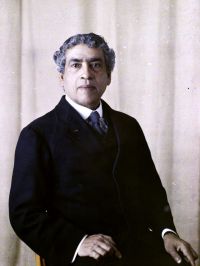
Portrait of Jagadish Chandra Bose Jagadish Chandra Bose On a Complete Apparatus for the Study of the Properties of Electric Waves (1897)

I ultimately succeeded in constructing a few instruments with which I was able to obtain the values of the indices of refraction of various substances for electric waves, the wave-length of electric radiation, to demonstrate the phenomena of double refraction and polarization of the electric rays, and to find out certain substances which act as electric tourmalines. The simplified apparatus with which many of the properties of electromagnetic radiation may be studied is here exhibited.
Source: Wikisource

Portrait of Jagadish Chandra Bose Jagadish Chandra Bose On a Complete Apparatus for the Study of the Properties of Electric Waves (1897)

Opacity due to Multiple Refraction and Reflexion.—An experiment analogous to the opacity of powdered glass to light is shown by filling a long trough with irregular-shaped pieces of pitch, and interposing it between the radiator and the receiver. The electric ray is unable to pass through the heterogeneous media, owing to the multiplicity of refractions and reflexions, and the receiver remains unaffected. But on restoring partial homogeneity by pouring in kerosene, which has about the same refractive index as pitch, the radiation is easily transmitted.
Source: Wikisource

Portrait of Jagadish Chandra Bose Jagadish Chandra Bose On a Complete Apparatus for the Study of the Properties of Electric Waves (1897)

If we take into account the entire range of radiation there is hardly a substance which is not, in this sense, coloured. In the spectrum of radiation transmitted through glass, for example, two broad absorption-bands would be observed, one in the ultra-violet, and the other in the infra-red, the electric and the visible rays not being absorbed to any great extent.
Source: Wikisource

Get perspective with Kwize: daily news enlightened by great literature