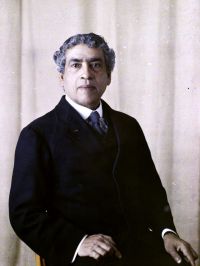
Jagadish Chandra Bose

Jagadish Chandra Bose

Summary

Portrait of Jagadish Chandra Bose Jagadish Chandra Bose On the Strain Theory of Photographic Action (1901)

It is an arbitrary distinction to call a phenomenon either physical or chemical when it happens to be on the common borderland. I have shown that when a substance is molecularly strained by light, its chemical activity is modified in consequence of the physical strain. The acted and the unacted portions will therefore be unequally attacked by a developer. In the case of a compound, the strain produced by light may cause a modification which renders it susceptible to decomposition by the action of a reducing agent.
Source: Wikisource

Portrait of Jagadish Chandra Bose Jagadish Chandra Bose On the Strain Theory of Photographic Action (1901)

It is obvious that any method which attempts to develop the after-effect a long time after the exposure will not be successful in cases where there is quick self-recovery. It will only be successful where the strain effect is more or less permanent.
It is thus seen that it is quite possible for a substance to be sensitive to radiation, and yet seem to show no effect capable of photographic development, owing to rapid self-recovery.
Source: Wikisource

Portrait of Jagadish Chandra Bose Jagadish Chandra Bose On the Strain Theory of Photographic Action (1901)

Our uncertainty with regard to the correct theory of photographic action is due to great experimental difficulties in studying the problem. As for instance:—
(1.) There is reason to believe that every substance is molecularly affected by radiation, but detection of change is rendered impossible by the imperfections of methods hitherto available, and also by the subsequent self-recovery of the substance in darkness. The effects can be detected in a few cases only when the changes produced happen to be visible, or become visible on development.
Source: Wikisource

Get perspective with Kwize: daily news enlightened by great literature