Summary

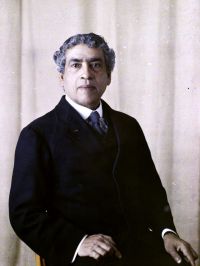
Portrait of Jagadish Chandra Bose Jagadish Chandra Bose On the Continuity of Effect of Light and Electric Radiation on Matter (1901)

We thus see how the response is dependent on the molecular condition, and how a change of this condition may even give rise to a reversal of response, say, from a diminution to an increase of resistance. The nature of the chemical substance, the molecular condition, the intensity and duration of radiation, the pressure, the temperature, and even the electromotive force used for detection, are the factors which are instrumental in the modification of the final response. I have already shown [3] how the increasing effect of continuous radiation may produce molecular reversal.
Source: Wikisource

Portrait of Jagadish Chandra Bose Jagadish Chandra Bose On the Continuity of Effect of Light and Electric Radiation on Matter (1901)

When a substance is strained by radiation there is produced a sudden variation of conductivity. The substance will recover from the strained condition (1) if it has not been overstrained by an excessive stimulus, or (2) if its electric elasticity be very great. I have found in general that on careful adjustment of a receiver there is a tendency to self-recovery if the intensity of incident radiation is not too strong. In the case of substances which are, electrically speaking, highly elastic, such as K, there is an automatic recovery even when the stimulus is strong.
Source: Wikisource

Portrait of Jagadish Chandra Bose Jagadish Chandra Bose On the Continuity of Effect of Light and Electric Radiation on Matter (1901)

It is, however, more satisfactory to study the effect of light in producing electromotive variation. Becquerel, Minchin, and others have shown that light produces electromotive variation in a photo-electric cell. Like electric radiation, the effect of light is not confined to any particular metal or groups of metals, but all metals exhibit an electromotive variation under its action. Two opposite effects are likewise shown; in some cases the potential is raised, in other cases the potential is lowered by the action of light.
Source: Wikisource

Get perspective with Kwize: daily news enlightened by great literature