Summary

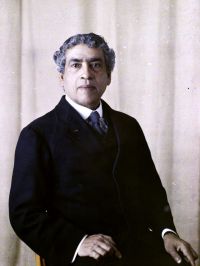
Portrait of Jagadish Chandra Bose Jagadish Chandra Bose On Electromotive Wave accompanying Mechanical Disturbance in Metals in Contact with Electrolyte (1902)

The effect of weak solution is sometimes the opposite to that of strong solution. By touching different points of the wire with different reagents, the excitability of these portions are rendered unequal. Hence a resultant electromotive variation may be obtained by Vibrating the wire as a whole. The current in the Wire is from the less to the more excitable. By this method, invisible traces of physico-chemical change in a wire may be detected. Chemical reagents not only change the excitability but the quickness of response.
Source: Wikisource

Portrait of Jagadish Chandra Bose Jagadish Chandra Bose On Electromotive Wave accompanying Mechanical Disturbance in Metals in Contact with Electrolyte (1902)

When one point is acted on by a chemical reagent, not only is its electric excitability changed, but its time relations—its latent period, the time-rate of its acquiring the maximum electric variation, and the recovery from the effect of stimulus—will also be modified. Using the block method, we may place a drop of excitant Na2CO3 on A and depressant KBr on B. On simultaneous vibration of A and B, the A effect being relatively much stronger than B effect, the resultant would be an upward deection.
Source: Wikisource

Portrait of Jagadish Chandra Bose Jagadish Chandra Bose On Electromotive Wave accompanying Mechanical Disturbance in Metals in Contact with Electrolyte (1902)

But the modification of which I have spoken does not stop short of more abolition of responsive power, but sometimes proceeds further, and actually reverses the sign of response—the excited wire becoming cuproid. This abnormal effect is sometimes found even in fresh unannealed wires, when feeble vibrations (of amplitude of 5° or less) may give rise to a negative response, but vibration of stronger intensity gives rise to the usual positive response. At other times the molecular modification is more pronounced, and there is a persistent reversal of response.
Source: Wikisource

Get perspective with Kwize: daily news enlightened by great literature