Summary

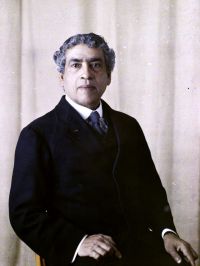
Portrait of Jagadis Chandra Bose Jagadis Chandra Bose Life Movements in Plants, Volume II

So very anomalous are these various effects that Pfeffer, after showing the inadequacy of different theories that have been advanced, came to the conclusion that "the precise character of the stimulatory action of light has yet to be determined. When we say that an organ curves towards a source of illumination because of its heliotropic irritability, we are simply expressing an ascertained fact in a conveniently abbreviated form, without explaining why such curvature is possible or how it is produced."
Source: Gutenberg

Portrait of Jagadis Chandra Bose Jagadis Chandra Bose Life Movements in Plants, Volume II

An external agent, say light, causes certain excitatory change in the tissue, and we refer to the agent which induces it, as the stimulus. Thus in the instance cited above, light is the stimulus, and it is the stimulus-effect that is transmitted to a distance. But in physiological literature no distinction is made between the stimulus and its effect, hence arises frequent use of the phrase 'transmission of stimulus'. It is obvious that it is not light but its effect that is transmitted.
Source: Gutenberg

Portrait of Jagadis Chandra Bose Jagadis Chandra Bose Life Movements in Plants, Volume II

It is with great surprise that one comes to realise the fact that the effect of one form of stimulus can be so exactly balanced by that of another, so entirely different, and that the stimulus of gravity could be measured, as it were, in candle powers of light! After securing the balance, light was cut off, and the geotropic torsion became renewed on the cessation of the counteracting phototropic action.
Source: Gutenberg

Get perspective with Kwize: daily news enlightened by great literature