Summary

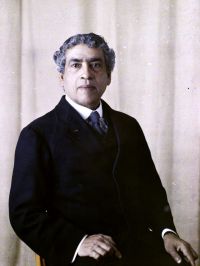
Portrait of Jagadis Chandra Bose Jagadis Chandra Bose Response in the Living and Non-Living

We have seen that stimulus produces a certain excitatory change in living substances, and that the excitation produced sometimes expresses itself in a visible change of form, as seen in muscle; that in many other cases, however—as in nerve or retina—there is no visible alteration, but the disturbance produced by the stimulus exhibits itself in certain electrical changes, and that whereas the mechanical mode of response is limited in its application, this electrical form is universal.
Source: Gutenberg

Portrait of Jagadis Chandra Bose Jagadis Chandra Bose Response in the Living and Non-Living

We have seen that amongst the phenomena of response, there is no necessity for the assumption of vital force. They are, on the contrary, physico-chemical phenomena, susceptible of a physical inquiry as definite as any other in inorganic regions.
Physiologists have taught us to read in the response-curves a history of the influence of various external agencies and conditions on the phenomenon of life. By these means we are able to trace the gradual diminution of responsiveness by fatigue, by extremes of heat and cold, its exaltation by stimulants, the arrest of the life-process by poison.
Source: Gutenberg

Portrait of Jagadis Chandra Bose Jagadis Chandra Bose Response in the Living and Non-Living

An ordinary nerve, normally connected with its terminal organs, gives sign of life by means of muscle, which by direct or reflex path is set in motion when the nerve trunk is stimulated. But such nerve separated from its natural termini, isolated from the rest of the organism, gives no sign of life when excited, either in the shape of chemical or of thermic changes, and it is only by means of an electrical change that we can ascertain whether or no it is alive ... The most general and most delicate sign of life is then the electrical response.’—Waller, in Brain, pp.
Source: Gutenberg

Get perspective with Kwize: daily news enlightened by great literature