Summary

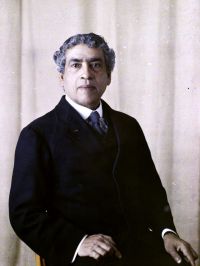
Portrait of Jagadish Chandra Bose Jagadish Chandra Bose On a Self-recovering Coherer and the Study of the Cohering Action of different Metals (1899)

Sodium—As we pass from potassium to the neighbouring metals, there is a gradual transition of property as regards the nature of response to electric waves. With sodium the adjustment is a little more difficult than with potassium, but the response is somewhat similar to that of potassium. Though in general there is an increase of resistance produced by electric radiation, there are occasional exceptions when a diminution of resistance is produced. With some trouble the adjustment could be made so that the recovery is also automatic, but it is not so energetic as in the case of potassium.
Source: Wikisource

Portrait of Jagadish Chandra Bose Jagadish Chandra Bose On a Self-recovering Coherer and the Study of the Cohering Action of different Metals (1899)

With the arrangement described above the action of radiation on metallic contacts was studied, a brief account of which will be given under their respective groupings. It may here be mentioned that certain metals which do not usually show any contact-sensitiveness can be made to exhibit it by very careful manipulation. The nature of the response of a coherer is to a certain extent modified by its condition and particular adjustment. A coherer freshly made is more difficult to adjust, but at the same time far more sensitive.
Source: Wikisource

Portrait of Jagadish Chandra Bose Jagadish Chandra Bose On a Self-recovering Coherer and the Study of the Cohering Action of different Metals (1899)

By Jagadis Chunder Bose, M.A., D.Sc., Professor of Physical Science, Presidency College, Calcutta. Communicated by Lord Rayleigh, F.R.S. Received March 6,—Read April 27, 1899. In working with coherers, made of iron or steel, some special difficulties are encountered in the warm and damp climate of Bengal.
Source: Wikisource

Get perspective with Kwize: daily news enlightened by great literature