Summary

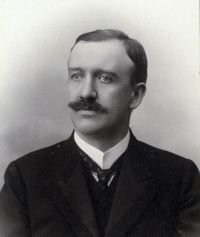
Portrait of Friedrich Hasenöhrl Friedrich Hasenöhrl Translation:On the Theory of Radiation in Moving Bodies… (1905)

Therefore, the amount stems from the total radiating energy in the moving cavity:
thus
from the heat supply of the walls, while the amount
is gained from the work.
This result is now in full agreement with the one of Abraham. Because the work which was spent to bring the system to a certain velocity, can be calculated from momentum by
if one inserts for its value, then the integration indeed provides the value .
Source: Wikisource

Portrait of Friedrich Hasenöhrl Friedrich Hasenöhrl Translation:On the Theory of Radiation in Moving Bodies… (1905)

The absolute radiation that corresponds to it, is:
Now, according to Abraham, the density of the electromagnetic momentum is equal to the absolute radiation divided by . [5] Thus if we calculate the total electromagnetic momentum which coincides with the direction of the system and which is contained in the cavity, we have to calculate expression (1) with , then to integrate with respect to from O to , and then to multiply the result with the volume of cavity . If we additionally substitute for its value [6] , then the momentum becomes
Source: Wikisource

Portrait of Friedrich Hasenöhrl Friedrich Hasenöhrl Translation:On the Theory of Radiation in Moving Bodies… (1905)

If one neglects magnitudes beginning with order , then it is
(These values are related to quasi-stationary, reversible velocity changes; twice of the work must be spent at sudden accelerations of the system. In the latter case, one obtains for the apparent mass; the relevant calculation executed by me in an earlier work [8] , is free of the mentioned calculation error. Though the concept of an apparent mass is probably to be confined to quasi-stationary motions.)
Source: Wikisource

Get perspective with Kwize: daily news enlightened by great literature