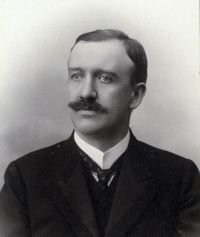
 Friedrich Hasenöhrl,
Translation:On the Thermodynamics of Moving Systems
(1907)
Friedrich Hasenöhrl,
Translation:On the Thermodynamics of Moving Systems
(1907)
“ Thus we come to the result: When the volume decreases with velocity according to the previous law, i.e. when the dimensions of matter are contracting in the direction of motion in the ratio , then the pressure of every body remains unchanged at adiabatic change of velocity, while the temperature of all bodies decreases in the same measure. Then, no influence of a common translatory motion is observable. This is in agreement with the contraction hypothesis of H. A. Lorentz, as well as with the theorems derived by Planck from the so called relativity principle. ”
