Summary

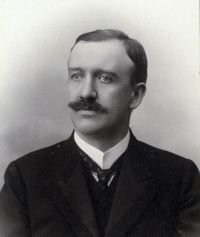
Portrait of Friedrich Hasenöhrl Friedrich Hasenöhrl Translation:On the Theory of Radiation in Moving Bodies (1904)

If one now assumes in accordance with the old theory of light, that the energy of a wave train is caeteris paribus inversely proportional to the square of the wavelength per unit length, i.e., that one energy quantity (which is inversely proportional to the first power of its length) is connected to one wave, then (since the number of emanated waves is the same in both cases) the radiation of the moving body is related to that of the resting one, by the inverse proportion of the wavelengths.
Source: Wikisource

Portrait of Friedrich Hasenöhrl Friedrich Hasenöhrl Translation:On the Theory of Radiation in Moving Bodies (1904)

If we again imagine a system, consisting of a (black) energy reservoir of temperature , and a cavity surrounded by mirrors of volume . Let the system at first be at rest, and the cavity be in connection with the heat reservoir, so that the radiation energy is present in the first one. If we now bring the system to velocity , then the heat reservoir gives off the heat to the cavity; at the same time, the work must be performed. Now we separate the cavity from the heat reservoir by a mirror, and bring the velocity of our system to zero again.
Source: Wikisource

Portrait of Friedrich Hasenöhrl Friedrich Hasenöhrl Translation:On the Theory of Radiation in Moving Bodies (1904)

Under absolute radiation one understands the energy quantity, which traverses (in unit time) the unit surface of an absolutely resting plane situated perpendicular of the absolute beam direction. This energy quantity is equal to the heat, absorbed by the unit surface of an equally located black plane.
Under total relative radiation we understand the energy quantity, which traverses (in unit time) the unit surface of an (imagined) plane, moving with absolute velocity , and which is oriented perpendicular to the relative beam direction.
Source: Wikisource

Get perspective with Kwize: daily news enlightened by great literature