Summary

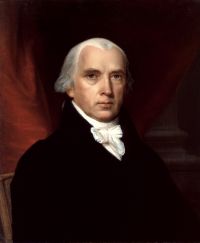
Portrait of James Madison James Madison Spirit of Governments — Essays… (1792)

No government is perhaps reducible to a sole principle of operation. Where the theory approaches nearest to this character, different and often heterogeneous principles mingle their influence in the administration. It is useful, nevertheless, to analyze the several kinds of government, and to characterize them by the spirit which predominates in each.
Source: Wikisource

Portrait of James Madison James Madison Spirit of Governments — Essays… (1792)

A government operating by corrupt influence, substituting the motive of private interest in place of public duty, converting its pecuniary dispensations into bounties to favorites or bribes to opponents, accommodating its measures to the avidity of a part of the nation instead of the benefit of the whole; in a word, enlisting an army of interested partisans, whose tongues, whose pens, whose intrigues, and whose active combinations, by supplying the terror of the sword, may support a real domination of the few, under an apparent liberty of the many.
Source: Wikisource

Portrait of James Madison James Madison Spirit of Governments — Essays… (1792)

It is happy for the New World that it is not on the west side of the Atlantic. It will be both happy and honorable for the United States if they never descend to mimic the costly pageantry of its form, nor betray themselves into the venal spirit of its administration.
Thirdly. A government deriving its energy from the will of the society, and operating, by the reason of its measures, on the understanding and interest of the society. Such is the government for which philosophy has been searching and humanity been fighting from the most remote ages.
Source: Wikisource

Get perspective with Kwize: daily news enlightened by great literature