Summary

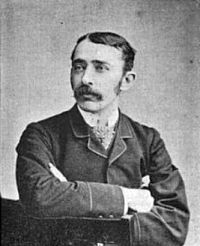
Portrait of John Ambrose Fleming John Ambrose Fleming 1911 Encyclopædia Britannica, Volume 28… (1911)

It is always an advantage, if possible, to employ an electrostatic voltmeter for measuring potential difference if it is necessary to keep the voltmeter permanently connected to the two points. Any form of electrokinetic voltmeter which involves the passage of a current through the wire necessitates the expenditure of energy to maintain this current and therefore involves cost of production.
Source: Wikisource

Portrait of John Ambrose Fleming John Ambrose Fleming 1911 Encyclopædia Britannica, Volume 28… (1911)

If the needle is connected to one terminal of a circuit, and the fixed plates or cells to the other member of the circuit, and a difference of potential is created between them, then the movable needle is drawn in so that the aluminium blades are more included between the fixed plates. This movement is resisted by the torsional elasticity of the suspending wire, and hence a fixed indicating needle attached to the movable system can be made to indicate directly on a scale the difference of potential between the terminals of the instrument in volts.
Source: Wikisource

Portrait of John Ambrose Fleming John Ambrose Fleming 1911 Encyclopædia Britannica, Volume 28… (1911)

As the frame has the same linear expansion as the wire, external changes of the temperature will not affect their relative length, but if the fine wire is heated by the passage of an electric current, its expansion will move the indicating needle over the scale, the motion being multiplied by the gear. In the Hartmann and Braun form of hot-wire voltmeter, the fine wire is fixed between two supports, and the expansion produced when a current is passed through it causes the wire to sag down, the sag being multiplied by a gear and made to move an indicating needle over a scale.
Source: Wikisource

Get perspective with Kwize: daily news enlightened by great literature