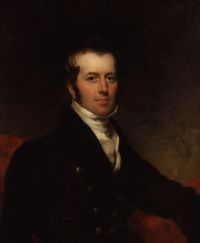
John George Children

John George Children

Summary

Portrait of John George Children John George Children Proceedings of the Royal Society of London (1833)

All the zinc plates were connected together as one zinc plate, and also all the copper plates connected as one copper plate. A communication was then made between the two sets of plates thus connected, but not immersed in a fluid, and all the electricity supposed to move in consequence of the contact, was made to pass through a wire of platina 1/5000th of an inch in diameter, and about 1/30th of an inch in length; but there was no appearance of ignition, although the same wire may be instantly ignited by a single pair of one inch plates immersed in a weak acid.
Source: Wikisource

Portrait of John George Children John George Children Proceedings of the Royal Society of London (1833)

The first series of experiments were on the comparative liability of different metals to be ignited by the power of this battery, by joining equal lengths of any two wires in the same line, and making the circuit through both thus connected. In the comparison of platina and iron, which of all metals are most easily ignited, the difference was so little, that their comparative ignition altered during the experiment in consequence of apparent difference in their capacities, as well as conducting powers.
Source: Wikisource

Portrait of John George Children John George Children Proceedings of the Royal Society of London (1833)

The battery with which these experiments were made, has 21 cells, each containing about 40 gallons of water, to which was added a mixture of nitric and sulphuric acids, at various intervals, beginning with 1/40th, and ending with 1/20th part of the water. Into each cell was immersed a zinc plate, with a pair of copper plates, one on each side, but connected together at the bottom, and also duly connected to the zinc in the cell adjacent.
Source: Wikisource

Get perspective with Kwize: daily news enlightened by great literature