Summary

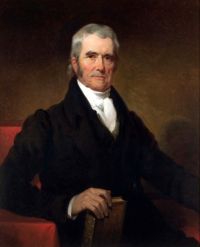
Portrait of John Marshall John Marshall Caldwell v. Carrington's Heirs…

Paul Carrington, the father of George, deposes that he owned a tract of land in the county of Halifax, called Dry Branch, containing five hundred and ninety-six acres, the whole of which, at the close of the revolutionary war, he gave to his son George, put him in possession, delivered the title papers, and directed him to prepare a deed. In 1787 or 1788, George requested the deponent to convey the land to John Williams, to whom he had sold it, in exchange for his military lands in Kentucky.
Source: Wikisource

Portrait of John Marshall John Marshall Caldwell v. Carrington's Heirs…

The statute of frauds, of which the defendants claimed the benefit, avoids parol contracts for land, and will unquestionably avoid that between John Williams and George Carrington, unless the transactions between the parties take the case out of the statute. The appellees maintain the affirmative of this proposition, and contend that the complete execution of the contract on the part of George Carrington, by conveying the Dry Branch tract to the vendee of John Williams, supplies in law the want of a memorandum in writing.
Source: Wikisource

Portrait of John Marshall John Marshall Caldwell v. Carrington's Heirs…

Now he knew, or might have known, that the suit was instituted in the county of Halifax, that being the residence of Williams, whose agent he was, and who was the defendant in the suit. He could have received full information from Williams himself, who never attempted to conceal the claim. His conveyance of the two thousand acres of his claim, lying south of the Tennessee river, dated the day after his conveyance to Brents; contains a stipulation respecting the claim of Carrington's heirs, showing plainly that the claim was previously well known to the parties.
Source: Wikisource

Get perspective with Kwize: daily news enlightened by great literature