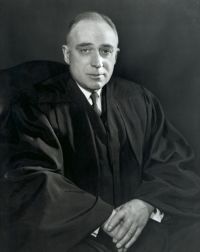
John Marshall Harlan II

John Marshall Harlan II

Summary

Portrait of John Marshall Harlan II John Marshall Harlan II Douglas v. California — Dissent

Every financial exaction which the State imposes on a uniform basis is more easily satisfied by the well-to-do than by the indigent. Yet I take it that no one would dispute the constitutional power of the State to levy a uniform sales tax, to charge tuition at a state university, to fix rates for the purchase of water from a municipal corporation, to impose a standard fine for criminal violations, or to establish minimum bail for various categories of offenses. Nor could it be contended that the State may not classify as crimes acts which the poor are more likely to commit than are the rich.
Source: Wikisource

Portrait of John Marshall Harlan II John Marshall Harlan II Douglas v. California — Dissent

In holding that an indigent has an absolute right to appointed counsel on appeal of a state criminal conviction, the Court appears to rely both on the Equal Protection Clause and on the guarantees of fair procedure inherent in the Due Process Clause of the Fourteenth Amendment, with obvious emphasis on 'equal protection.' In my view the Equal Protection Clause is not apposite, and its application to cases like the present one can lead only to mischievous results.
Source: Wikisource

Portrait of John Marshall Harlan II John Marshall Harlan II Douglas v. California — Dissent

To so construe it would be to read into the Constitution a philosophy of leveling that would be foreign to many of our basic concepts of the proper relations between government and society. The State may have a moral obligation to eliminate the evils of poverty, but it is not required by the Equal Protection Clause to give to some whatever others can afford.
Source: Wikisource

Get perspective with Kwize: daily news enlightened by great literature