Summary

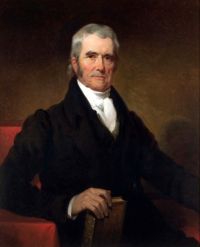
Portrait of John Marshall John Marshall Kirkman v. Hamilton — Opinion of the Court

It does not bar actions of debt generally, but those only which are brought for arrearages of rent. This is not brought for arrearages of rent; and is consequently not barred.
The action of debt, unless it be brought for arrearages of rent, not being within this statute, the court perceives no other which bars it. If the seventh section of the thirty-first chapter of the act of 1715 was even to be considered as adopting the act of limitations of the fourth of James I., it would not affect this case, because the suit was brought within the time allowed by that act.
Source: Wikisource

Portrait of John Marshall John Marshall Kirkman v. Hamilton — Opinion of the Court

Whether the plea of the statute of limitations is a bar to the recovery of the plaintiff, on the second count in the declaration? 2. Whether an action of debt can be supported on the cause of action set forth in said second count? 3. Whether the averment of the citizenship of Thomas Ramsey & Co., the payees of the note in the said second count, is sufficient to sustain the jurisdiction of this court, under the provisions of the eleventh section of the judiciary act of 1789?
Source: Wikisource

Portrait of John Marshall John Marshall Kirkman v. Hamilton — Opinion of the Court

The proviso of the fifth section, that 'the act of limitations shall apply to all bonds, bills, and other securities hereafter executed, made transferable by this act, after the assignment or indorsement thereof, in the same manner as it operates by law against promissory notes,' cannot, we think, be fairly construed to extend the act of limitations in its operation on promissory notes.
Source: Wikisource

Get perspective with Kwize: daily news enlightened by great literature