Summary

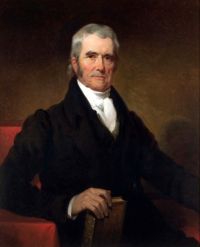
Portrait of John Marshall John Marshall Lagrange v. Chouteau — Opinion of the Court

The right of the plaintiff to liberty was supposed by the court to depend on the question of his being purchased in fact by a citizen of Illinois, and on his being carried to Illinois with a view to a residence in that state. The facts were left to the jury, and found for the defendant. It is not perceived that any act of congress has been misconstrued.
Source: Wikisource

Portrait of John Marshall John Marshall Lagrange v. Chouteau — Opinion of the Court

He, however, ultimately agreed to buy the said slave for Mr Chouteau, take him down the river, and keep him there some months, and then deliver him to the defendant. He accordingly bought the slave, took him to St. Genevieve in Missouri, and put him to work at mine La Motte, with some other hands. Some time afterwards he was sent to Kaskaskias, and put on board a keel boat as a hand. After remaining there about two days, he went in the boat to New Orleans, whence he returned to Kaskaskias about the 30th of March 1817, as a hand in the boat.
Source: Wikisource

Get perspective with Kwize: daily news enlightened by great literature