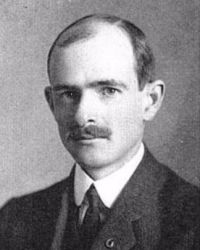
Joseph Grinnell

Joseph Grinnell

The Condor (1922)

Summary

Portrait of Joseph Grinnell Joseph Grinnell,  The Condor (1922)

“ Thus the idea of concealment of the location of its nest does not enter into its thoughts or instincts. Those nests which I have found have been so situated that a clear outlook could be obtained in at least two directions. The hummingbird while incubating seems to require but little time for procuring food, as I have seldom found them absent from their eggs, and of course the female is not relieved by her mate, as is the case with so many birds, nor is she fed by him as are the female finches. ”
Source: Wikisource

Portrait of Joseph Grinnell Joseph Grinnell,  The Condor (1922)

“ The birds were in sparse brush (Garrya, Kunzia, Artemisia tridentata, and Cercocarpus betulaefolius) ; and a digger pine and a pinyon both grew within one hundred feet of where they were discovered.
I was first attracted by the broken, post-nuptially rendered song of the male—intermittent and sketchy, yet distinct enough from the songs of other vireos to be recognized at once. This male Gray Vireo was promptly shot. It proved to be in molt, with only two of the old tall-feathers remaining and with new feathers showing where old ones had fallen out, in the wings and in most of the body tracts.
”
Source: Wikisource

Portrait of Joseph Grinnell Joseph Grinnell,  The Condor (1922)

“ First, only two eggs are laid and presumably only one brood raised each year by the Costa Hummingbird; second, the period during which the young are confined to the nest is from 50 percent to 100 percent greater than in the case of the smaller passerine species; third, the young are entirely dependent upon the female parent for sustenance. That the hummingbirds are able to maintain their numbers under these handicaps can but increase our admiration for these tiny but highly specialized and intelligent creatures. ”
Source: Wikisource

Get perspective with Kwize: daily news enlightened by great literature