Summary

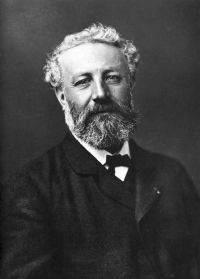
Portrait of Jules Verne Jules Verne,  Around the Moon — Chapter VI (1873)

“ Ah! my dear comrades, it will be rather curious to have the earth for our moon, to see it rise on the horizon, to recognize the shape of its continents, and to say to oneself, `There is America, there is Europe;' then to follow it when it is about to lose itself in the sun's rays! ”
Source: Wikisource

Portrait of Jules Verne Jules Verne,  Around the Moon — Chapter VI (1873)

“ By the bye, Barbicane, have the Selenites eclipses?"
"Yes, eclipses of the sun," replied Barbicane, "when the centers of the three orbs are on a line, the earth being in the middle. But they are only partial, during which the earth, cast like a screen upon the solar disc, allows the greater portion to be seen."
"And why," asked Nicholl, "is there no total eclipse? Does not the cone of the shadow cast by the earth extend beyond the moon?"
”
Source: Wikisource

Portrait of Jules Verne Jules Verne,  Around the Moon — Chapter VI (1873)

“ The sun and stars appeared exactly as they do to us upon earth. As to the moon, she was considerably larger; but the travelers' glasses, not very powerful, did not allow them as yet to make any useful observations upon her surface, or reconnoiter her topographically or geologically.
Thus the time passed in never-ending conversations all about the moon. Each one brought forward his own contingent of particular facts; Barbicane and Nicholl always serious, Michel Ardan always enthusiastic.
”
Source: Wikisource

Get perspective with Kwize: daily news enlightened by great literature