Summary

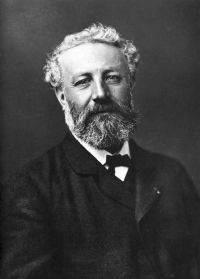
Portrait of Jules Verne Jules Verne,  Around the Moon — Chapter XIX (1873)

“ Here the projectile must strike the earth with a speed of 115,200 miles per hour.
"We are lost!" said Michel coolly.
"Very well! if we die," answered Barbicane, with a sort of religious enthusiasm, "the results of our travels will be magnificently spread. It is His own secret that God will tell us! In the other life the soul will want to know nothing, either of machines or engines! It will be identified with eternal wisdom!"
"In fact," interrupted Michel Ardan, "the whole of the other world may well console us for the loss of that inferior orb called the moon!"
”
Source: Wikisource

Portrait of Jules Verne Jules Verne,  Around the Moon — Chapter XIX (1873)

“ This change, which Barbicane verified, did not fail to surprise them. If the projectile was to gravitate round the satellite in an elliptical orbit, why was not its heaviest part turned toward it, as the moon turns hers to the earth? That was a difficult point.
In watching the course of the projectile they could see that on leaving the moon it followed a course analogous to that traced in approaching her. It was describing a very long ellipse, which would most likely extend to the point of equal attraction, where the influences of the earth and its satellite are neutralized.
”
Source: Wikisource

Portrait of Jules Verne Jules Verne,  Around the Moon — Chapter XIX (1873)

“ When the earth is nearest the sun she is in her perihelion; and in her aphelion at the farthest point. Speaking of the moon, she is nearest to the earth in her perigee, and farthest from it in her apogee. To use analogous expressions, with which the astronomers' language is enriched, if the projectile remains as a satellite of the moon, we must say that it is in its "aposelene" at its farthest point, and in its "periselene" at its nearest. ”
Source: Wikisource

Get perspective with Kwize: daily news enlightened by great literature