Summary

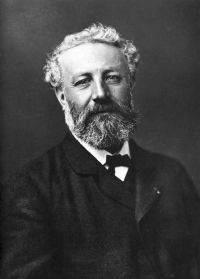
Portrait of Jules Verne Jules Verne Five Weeks in a Balloon — Chapter Thirty-Eighth… (1873)

Joe inquired how the Arabs managed to guide themselves across the desert, and come to the few wells scattered far between throughout this vast solitude.
"The Arabs," replied Dr. Ferguson, "are endowed by nature with a wonderful instinct in finding their way. Where a European would be at a loss, they never hesitate for a moment. An insignificant fragment of rock, a pebble, a tuft of grass, a different shade of color in the sand, suffice to guide them with accuracy. During the night they go by the polar star.
Source: Wikisource

Portrait of Jules Verne Jules Verne Five Weeks in a Balloon — Chapter Thirty-Eighth… (1873)

The sight of these birds led Joe to compliment his master on the idea of having two balloons.
"Where would we be," said he, "with only one balloon? The second balloon is like the life-boat to a ship; in case of wreck we could always take to it and escape."
"You are right, friend Joe," said the doctor, "only that my life-boat gives me some uneasiness. It is not so good as the main craft."
"What do you mean by that, doctor?" asked Kennedy.
"I mean to say that the new Victoria is not so good as the old one.
Source: Wikisource

Portrait of Jules Verne Jules Verne Five Weeks in a Balloon — Chapter Thirty-Eighth… (1873)

The forests gave place to jungles, which alligators, hippopotami, and the rhinoceros, made their haunts.
"It will not be long before we see the Niger," said the doctor. "The face of the country always changes in the vicinity of large rivers. These moving highways, as they are sometimes correctly called, have first brought vegetation with them, as they will at last bring civilization. Thus, in its course of twenty-five hundred miles, the Niger has scattered along its banks the most important cities of Africa."
Source: Wikisource

Get perspective with Kwize: daily news enlightened by great literature