Summary

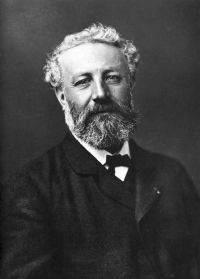
Portrait of Jules Verne Jules Verne Journey into the Interior of the Earth… (1877)

This roof itself is formed of fragments of rock carried down, of enormous stones, as if by some giant's hand; but at one time the expulsive force was greater than usual, and this block, like the falling keystone of a ruined arch, has slipped down to the ground and blocked up the way. It is only an accidental obstruction, not met by Saknussemm, and if we don't destroy it we shall be unworthy to reach the centre of the earth.
Source: Wikisource

Portrait of Jules Verne Jules Verne Journey into the Interior of the Earth… (1877)

We should never have seen the name of Saknussemm, and we should at this moment be imprisoned on a rockbound, impassable coast."
"Yes, Axel, it is providential that whilst supposing we were steering south we should have just got back north at Cape Saknussemm. I must say that this is astonishing, and that I feel I have no way to explain it."
"What does that signify, uncle? Our business is not to explain facts, but to use them!"
Source: Wikisource

Portrait of Jules Verne Jules Verne Journey into the Interior of the Earth… (1877)

We took our places, and with our sail set, Hans steered us along the coast to Cape Saknussemm.
The wind was unfavourable to a species of launch not calculated for shallow water. In many places we were obliged to push ourselves along with iron-pointed sticks. Often the sunken rocks just beneath the surface obliged us to deviate from our straight course. At last, after three hours' sailing, about six in the evening we reached a place suitable for our landing. I jumped ashore, followed by my uncle and the Icelander.
Source: Wikisource

Get perspective with Kwize: daily news enlightened by great literature