Summary

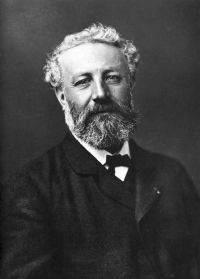
Portrait of Jules Verne Jules Verne Journey into the Interior of the Earth… (1877)

I stood on the very summit of the southernmost of Snæfell's peaks. The range of the eye extended over the whole island. By an optical law which obtains at all great heights, the shores seemed raised and the centre depressed. It seemed as if one of Helbesmer's raised maps lay at my feet. I could see deep valleys intersecting each other in every direction, precipices like low walls, lakes reduced to ponds, rivers abbreviated into streams. On my right were numberless glaciers and innumerable peaks, some plumed with feathery clouds of smoke.
Source: Wikisource

Portrait of Jules Verne Jules Verne Journey into the Interior of the Earth… (1877)

I raised my head and saw straight above me the upper aperture of the cone, framing a bit of sky of very small circumference, but almost perfectly round. Just upon the edge appeared the snowy peak of Saris, standing out sharp and clear against endless space.
At the bottom of the crater were three chimneys, through which, in its eruptions, Snæfell had driven forth fire and lava from its central furnace. Each of these chimneys was a hundred feet in diameter. They gaped before us right in our path.
Source: Wikisource

Portrait of Jules Verne Jules Verne Journey into the Interior of the Earth… (1877)

The day wore on, and no shadow came to lay itself along the bottom of the crater. Hans did not move from the spot he had selected; yet he must be asking himself what were we waiting for, if he asked himself anything at all. My uncle spoke not a word to me. His gaze, ever directed upwards, was lost in the grey and misty space beyond.
On the 26th nothing yet. Rain mingled with snow was falling all day long. Hans built a but of pieces of lava.
Source: Wikisource

Get perspective with Kwize: daily news enlightened by great literature