Summary

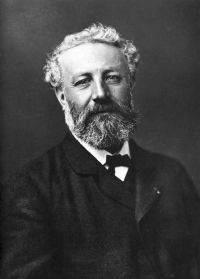
Portrait of Jules Verne Jules Verne Journey into the Interior of the Earth… (1877)

After the exhaustion of the basalt, the volcano, the power of which grew by the extinction of the lesser craters, supplied an egress to lava, ashes, and scoriae, of which I could see lengthened screes streaming down the sides of the mountain like flowing hair.
Such was the succession of phenomena which produced Iceland, all arising from the action of internal fire; and to suppose that the mass within did not still exist in a state of liquid incandescence was absurd; and nothing could surpass the absurdity of fancying that it was possible to reach the earth's centre.
Source: Wikisource

Portrait of Jules Verne Jules Verne Journey into the Interior of the Earth… (1877)

I must admit that my uncle kept as close to me as he could; he never lost sight of me, and in many straits his arm furnished me with a powerful support. He himself seemed to possess an instinct for equilibrium, for he never stumbled. The Icelanders, though burdened with our loads, climbed with the agility of mountaineers.
To judge by the distant appearance of the summit of Snæfell, it would have seemed too steep to ascend on our side.
Source: Wikisource

Portrait of Jules Verne Jules Verne Journey into the Interior of the Earth… (1877)

At seven we had ascended the two thousand steps of this grand staircase, and we had attained a bulge in the mountain, a kind of bed on which rested the cone proper of the crater.
Three thousand two hundred feet below us stretched the sea. We had passed the limit of perpetual snow, which, on account of the moisture of the climate, is at a greater elevation in Iceland than the high latitude would give reason to suppose. The cold was excessively keen. The wind was blowing violently.
Source: Wikisource

Get perspective with Kwize: daily news enlightened by great literature