Summary

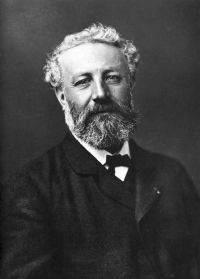
Portrait of Jules Verne Jules Verne Journey into the Interior of the Earth… (1877)

I could feel the heaving of the mountain, which seemed to breathe like a huge whale, and puff out fire and wind from its vast blowholes. Beneath, down a pretty steep declivity, ran streams of lava for eight or nine hundred feet, giving the mountain a height of about 1,300 or 1,400 feet. But the base of the mountain was hidden in a perfect bower of rich verdure, amongst which I was able to distinguish the olive, the fig, and vines, covered with their luscious purple bunches.
Source: Wikisource

Portrait of Jules Verne Jules Verne Journey into the Interior of the Earth… (1877)

I expected to see a white cone covered with the eternal snow of ages rising from the midst of the barren deserts of the icy north, faintly lighted with the pale rays of the arctic sun, far away in the highest latitudes known; but contrary to all our expectations, my uncle, the Icelander, and myself were sitting half-way down a mountain baked under the burning rays of a southern sun, which was blistering us with the heat, and blinding us with the fierce light of his nearly vertical rays.
Source: Wikisource

Portrait of Jules Verne Jules Verne Journey into the Interior of the Earth… (1877)

The slope of the volcano was in many places of great steepness. We slid down screes of ashes, carefully avoiding the lava streams which glided sluggishly by us like fiery serpents. As we went I chattered and asked all sorts of questions as to our whereabouts, for I was too much excited not to talk a great deal.
"We are in Asia," I cried, "on the coasts of India, in the Malay Islands, or in Oceania. We have passed through half the globe, and come out nearly at the antipodes."
"But the compass?" said my uncle.
Source: Wikisource

Get perspective with Kwize: daily news enlightened by great literature