Summary

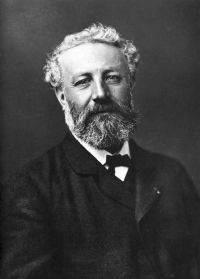
Portrait of Jules Verne Jules Verne Journey into the Interior of the Earth… (1877)

Why should it not, at a certain depth, attain an impassable limit, instead of rising to such a point as to fuse the most infusible metals?"
As my uncle was now taking his stand upon hypotheses, of course, there was nothing to be said.
"Well, I will tell you that true savants, amongst them Poisson, have demonstrated that if a heat of 360,000 degrees [1] existed in the interior of the globe, the fiery gases arising from the fused matter would acquire an elastic force which the crust of the earth would be unable to resist, and that it would explode like the plates of a bursting boiler."
Source: Wikisource

Portrait of Jules Verne Jules Verne Journey into the Interior of the Earth… (1877)

There are not a few in the scientific world who envy my success, and many would be ready to undertake this enterprise, to whom our return should be the first news of it."
"Do you really think there are many people bold enough?" said I.
"Certainly; who would hesitate to acquire such renown? If that document were divulged, a whole army of geologists would be ready to rush into the footsteps of Arne Saknussemm."
"I don't feel so very sure of that, uncle," I replied; "for we have no proof of the authenticity of this document."
Source: Wikisource

Portrait of Jules Verne Jules Verne Journey into the Interior of the Earth… (1877)

What is darkness to you is light to me. This proves the ingenious care with which Saknussemm guarded and defined his discovery. Sneffels, or Snæfell, has several craters. It was therefore necessary to point out which of these leads to the centre of the globe. What did the Icelandic sage do? He observed that at the approach of the kalends of July, that is to say in the last days of June, one of the peaks, called Scartaris, flung its shadow down the mouth of that particular crater, and he committed that fact to his document.
Source: Wikisource

Get perspective with Kwize: daily news enlightened by great literature