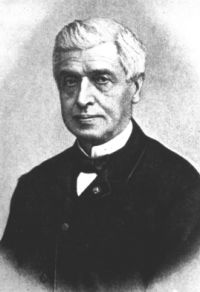
Gabriel Auguste Daubrée

Gabriel Auguste Daubrée

Summary

Portrait of Gabriel Auguste Daubrée Gabriel Auguste Daubrée Popular Science Monthly (1885)

It is evident that the solid envelope of the globe has undergone dislocations at many epochs in its history. The manifestations of gigantic force thus plainly registered are the effects of ancient back-foldings and of lateral or horizontal pressures. It is as if the crust of the earth had become too large for the supporting nucleus, and had, to keep in contact with it, to shrink up and bend upon itself. These foldings and fractures have given origin to chains of mountains.
Source: Wikisource

Portrait of Gabriel Auguste Daubrée Gabriel Auguste Daubrée Popular Science Monthly (1885)

Suppose a barrel of powder exploded in a cavity situated a hundred metres underground. At the surface we would hear a rumbling explosion, and feel a vertical shock within a limited space, and an undulatory thrill over a wider circle. The phenomenon will be much like that of an earthquake, except that the essential element of repetition will be wanting; for all will be over with the first shock. But, in the majority of earthquakes, the shocks come in succession, as if the cause of them were a regenerating one.
Source: Wikisource

Portrait of Gabriel Auguste Daubrée Gabriel Auguste Daubrée Popular Science Monthly (1885)

But, however overwhelming and disastrous in reference to our persons and buildings earthquakes may be, it must be borne in mind that the amplitude of their movements is wholly insignificant in proportion to the dimensions of the globe whose epidermis they shake. The phenomenon is rarely limited to a single shock. Generally, several shocks follow one upon another at short intervals. In many cases, the movements are repeated for months and years, with pauses of a variable duration, so as to form as a whole, till they are totally extinguished, what might be called a seismic period.
Source: Wikisource

Get perspective with Kwize: daily news enlightened by great literature